cross-posted from: https://scribe.disroot.org/post/12166708
[Original in French. This is an automated, paraphrased translation with minimal edits.]
The case was kept discreet but, by decision of the Paris Administrative Court on 1 October 2026, a Chinese national who had been living in Paris for years was sentenced to be expelled from French territory to China for running an illegal Chinese police officer, activities deemed to be “infringing the fundamental interests of the State.”
This Chinese national, identified only by the first letter of his name “M. A…”, born on 25 December 1968, was said to have entered France in February 2001. Following an investigation carried out by the French Ministry of the Interior and after an adversarial judgment handed down on 1 October 2026 after he had appealed, it was established that he had carried out "activities that harmed the fundamental interests of the State when he was de facto president of the Fujian Trade Industry Association (AICF), a Chinese community structure that hosted a clandestine “police station” called “Fuzhou Police Overseas Service Station,” underlines the judgment.
…
"This type of station is intended to serve as a relay on French territory to the Chinese Communist Party bodies responsible for controlling the Chinese diaspora.
…
According to the court judgement, there is a "picture of Mr. A posing in front of a banner on which appears the name of the liaison station ‘Fuzhou Police Overseas Service Station’ [that] gives detailed evidence of his involvement in the activities of the AICF.
…
The AICF’s affects “the sovereignty of the [French] State and its fundamental interests, and that its unsubstantiated denials do not make it possible to contradict,” explains the judgment.
…
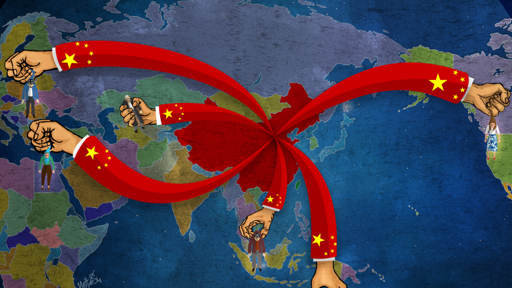
This case is only the emerging part of a tentacular system of transnational repression that the Chinese Communist Party (CPC) has illegally established in many countries with the aim of tracking dissidents or mere critics of the Party, especially members of ethnic minorities such as Tibetans or Uighurs, in order to at best silence them and at worst forcibly transfer them to China where, most often, they disappear without trace after their arrival on Chinese soil.
For example, French intelligence services dismantled nine Chinese clandestine police stations in its territory, according to several reliable sources in the French counter-espionage services. These officials sought to monitor, harass or forcibly repatriate political dissidents opposed to the Beijing regime.
…
In early 2026, the French counter-intelligence services closed nine clandestine “police stations” working for the interests of Beijing in France. According to the Ministry of the Interior, three “heads” of these Chinese phantom police stations were subjected to deportation measures. They were responsible, among other things, for controlling the Chinese diaspora and tracking opponents of the regime to forcibly return them to China. Two have already been expelled. On 9 June, in front of the 2nd and 7th chambers of the Council of State, the public rapporteur requested confirmation of the third expulsion.
…
Less visible than the Russian destabilization operations but equally present in the shadows, the illegal activity from Beijing abroad works largely through nationals without direct links with the Chinese state. A law of the People’s Republic of China of 28 June 2017 on intelligence created legal constraints requiring Chinese citizens and businesses to assist in the collection of information within the framework of the “United Front”, making any Chinese national a spy potential.
…
For a long time, the French authorities finally decided to raise the tone against these illegal agents, after having dealt in 2024 with the activism of secret agents duly listed at the Chinese embassy in Paris. The head of the post office in Paris of the Ministry of State Security (MSE, or Guoanbu, the Chinese secret service), and his deputy were thus asked to leave French territory after orchestrating, in March 2024, an attempted forced repatriation of a political dissident.
On 22 March 2024, at Roissy-Charles-de-Gaulle airport, together with five other individuals, they had tried to force 26-year-old Chinese dissident Ling Huazhan to embark for China. The police intervention ended the project. The victim lived alone and in a precarious way near Saint-Lazare station in Paris, after having taken refuge in Europe. Aimed by his country for “offensive action against the Chinese president,” he had relayed critical articles from the regime on social networks. According to the investigation of the Directorate-General for Internal Security, his passport had been subdued by members of the “illegal police station” located in a Chinese business near his home.
…
According to the NGO Safeguard Defenders, more than 100 undeclared police stations have been identified in more than 50 countries. The Chinese authorities have always denied any extra-judicial police activity, claiming that these are simple administrative centres to assist the diaspora (renewal of driving licences or passports). But the reality is different, as documented investigations by several Western countries, including the United States, Canada, the Netherlands and therefore France, describe the illegal activities of the Chinese Public Security Department-led antennas used for transnational repression and coercion of opponents.
…
According to article 63 of this unpublished text, adopted on 12 March 2026 by the National People’s Assembly (Parliament), Beijing claims its right to prosecute “organizations and individuals outside the territory of the People’s Republic of China that violate national unity or cause ethnic division.”
China’s President Xi Jinping’s “Law for the Promotion of Unity and the Progress of Nationalities” affirms a right of prosecution over any individual, in any country, in the name of strengthening unity among the 56 ethnic groups recognized by Beijing. The text has seven chapters and 65 articles covering education, language, publishing, the Internet, business activity and religion. Its scope extends explicitly to Hong Kong, Macao, Taiwan and the overseas Chinese communities.
…
The stated goal [of this Chinese Ethnic Unity Law] is to “forge a common consciousness of the Chinese nation,” directly resulting from Xi Jinping’s speeches since 2014. No limit of nationality or territory is specified. In concrete terms, a French, Japanese or American citizen may be subject to this clause simply by publicly criticizing Chinese policy towards the Uighurs, Tibetans or Taiwan.
The British think tank China Strategic Risks Institute warns about a strategy of “extraterritorial legal war,” where Chinese domestic law becomes a tool of pressure against foreign nationals who have never set foot in China.
Article 62 of China’s Ethnic Unity Law broadens the scope of action as it equates incitement and financing of activities deemed separatist or extremist with acts themselves, with the same criminal penalties. Many Western governments as well as human rights organisations have denounced this transnational legislation by definition illegal since it is contrary to the concept of national sovereignty.
…
Former French Senator André Gattolin explains that for repressive regimes, urges European states and like-minded partners for more cooperation.
Mr. Gattolin denounces "the near lack of coordination and cooperation of Western countries in the face of a transnational issue. “The stakes of close collaboration are all the more compelling for democracies as we have seen an international for a few years that does not say its name with the PRC [People’s Republic of China] as a leading figure.”
“Now in Europe, when it comes to explicitly challenging Beijing, everyone walks on eggs and often renegotiates to apply measures already enshrined in our law. Too often in proven cases of Chinese transnational repression, judicialization is rare and the identified authors benefit from an over-the-counter arrangement. Yet it is a question of sovereignty and the legitimate use of force by a State that is flouted,” he says.
…
Deport not arrest and imprison?
I assume because that would be ungentleman-like? /s
Probably just skipping a step before some sort of extradition treaty comes into effect. Besides, you gain nothing by holding him, and could make it tricky to get French nationals that will get detained in China in the future back home.
Canadians know all about arbitrary detainment. (The Michaels) But holding them gives you an exchange mechanism.
Just letting them walk send the message to do so with impunity and no consequences.
Normalizing this will only make it worse. China won’t be stopping, just pausing when they get caught. And in the future when they feel they’re above all repercussions they will detain whoever they want, for however long they want. Regardless of who cooperated in their oppression.